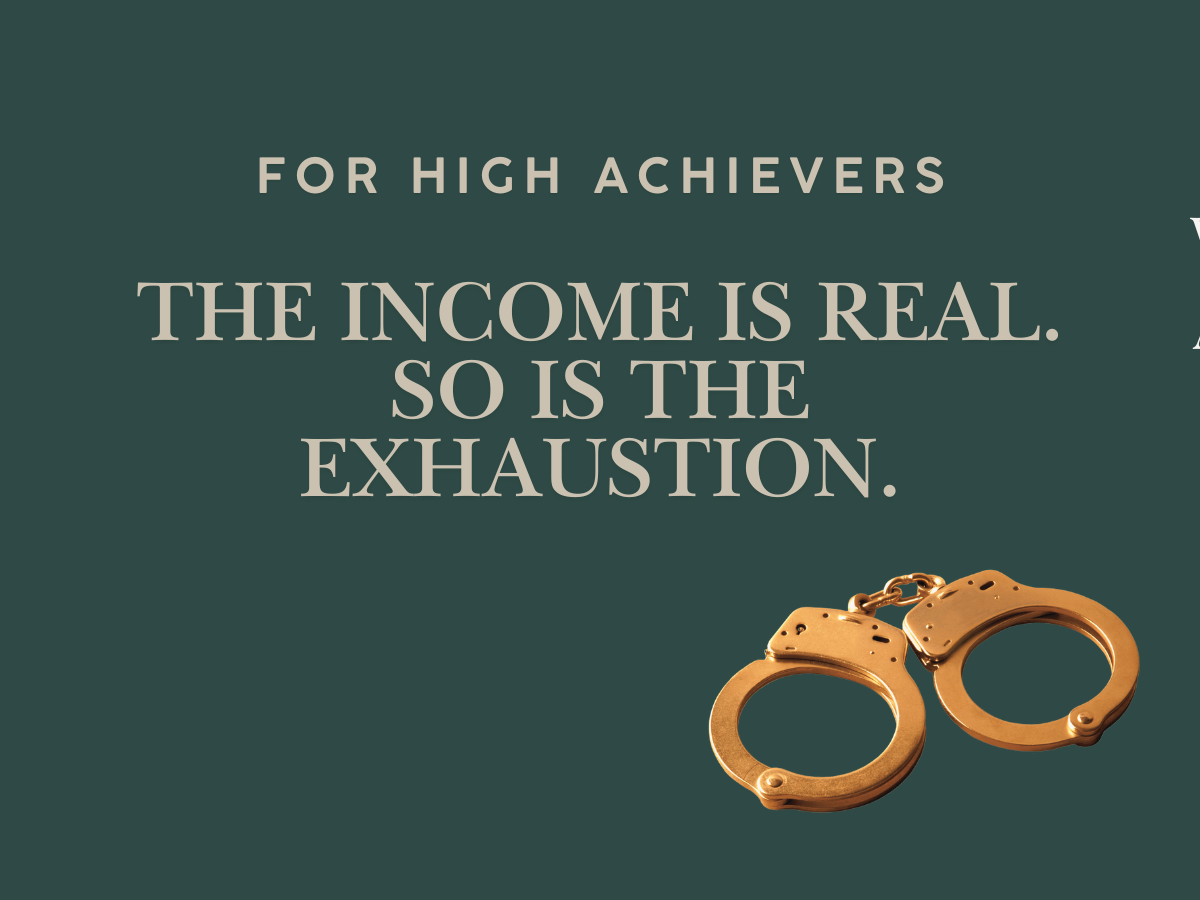
Therapy for High Achievers and Executives in Los Angeles
You’ve built a life that works on paper.
But internally, it’s harder than it should be.
Many of the high achievers we work with come in for perfectionism, but are actually navigating burnout or symptoms of high-functioning depression beneath the surface.


You perform at a high level. You follow through. People rely on you.
But internally, there’s pressure.
A constant sense you could be doing more, getting it more right, staying ahead.
For many high achievers, success doesn’t quiet that pressure.
It sharpens it.
You’re successful. And it still doesn’t feel like enough.
Change tends to feel gradual but deeply integrated.Who is this for?
High-performing professionals who are used to holding everything together without showing the cost of it
You might be:
An executive, founder, physician, or attorney
A high-performing professional managing significant responsibility
Someone others depend on, often without fully understanding the cost to you
You may notice:
A strong internal drive that is difficult to turn off
Pressure that follows you even when nothing is urgent
Difficulty slowing down without guilt
A sense that your worth is tied to performance
Relationships that feel secondary to work or responsibility
You are functioning. Leading. Producing.
But something underneath is not sustainable.
“You’re the one people rely on. But there’s a cost to holding it all together.”For a deeper clinical resource on this topic, see our complete guide to executive burnout in high-achieving professionals.
The Hidden Cost of Achievement


High achievement often comes with trade-offs that are not immediately visible.
You may be able to maintain a high level of performance while experiencing:
Persistent internal tension or low-grade anxiety
Emotional fatigue that does not resolve with rest
Limited access to your own needs, preferences, or limits
A pattern of pushing through rather than responding to yourself
Difficulty feeling fully present, even in moments that matter
Over time, performance can become less of a choice and more of a requirement.
What once helped you succeed can begin to quietly limit how you experience your life.
Perfectionism in High Achievers

Many high achievers are described as perfectionistic.
In our experience, perfectionism is not the core issue. It is a system.
It’s not something you simply “fix.”
It’s something you learn to understand and work with.
A way of organizing your behavior to maintain standards, avoid mistakes, and stay in control in environments where performance mattered.
This system is often effective. It creates results.
But it also comes with a cost:
Constant self-monitoring
Difficulty tolerating uncertainty
A narrowing of what feels acceptable or safe
The goal is not to remove this system.
It is to understand it, update it, and create flexibility where there is currently pressure.
Many high-achieving clients don’t initially come in saying they feel depressed.
They come in feeling exhausted, disconnected, or like they’ve lost their edge.
What often gets missed is that perfectionism and depression can look very similar on the surface, especially for high-functioning professionals. You may still be performing, showing up, and meeting expectations, but internally, something feels flat, heavy, or harder than it used to be.
We often see this across clients in Hermosa Beach and Manhattan Beach who are used to pushing through. Over time, that constant pressure can shift into something closer to burnout or depression.
If you’re noticing:
Less motivation for things you used to care about
A persistent sense of fatigue, even when you rest
Feeling emotionally numb or disconnected
Increased self-criticism despite high performance
It may not just be perfectionism. It may be a deeper level of emotional depletion that deserves attention.
If you're wondering whether what you're experiencing is closer to burnout or depression, you can explore more here:
Burnout & Chronic Stress
Depression Therapy
When Perfectionism Starts to Feel Like Depression

Burnout in High Achievers
Burnout in high achievers often looks different than expected.
You may still be performing well.
Which is why it often goes unnoticed until it becomes harder to ignore.
But internally, there may be:
A growing sense of depletion
Reduced capacity for engagement or enjoyment
Irritability or emotional flatness
A sense that everything requires effort
Because high achievers are skilled at continuing through difficulty, burnout is often missed or minimized.
Until it is not.
How We Work
We focus on the underlying drivers of your patterns, not just the surface experience.
Our approach integrates:
Internal Family Systems to understand the parts of you that push, strive, and maintain standards
EMDR to process underlying experiences that shape your current responses
Psychodynamic therapy to identify long-standing relational and identity patterns
In practice, this means:
Identifying what is driving the pressure behind your performance
Working directly with the parts of you that anticipate failure, exposure, or loss of control
Expanding your capacity to tolerate rest, uncertainty, and emotional experience
Developing a way of operating that is not dependent on constant pressure
This work is not about reducing ambition.It is about creating a more sustainable and flexible way to engage with it.


Why High Achievers Choose This Practice
Many high-achieving clients come here after trying therapy that felt helpful
but didn’t go far enough. Often, they describe it as helpful but limited.
What they find here is different.
A direct understanding of high-performance environments
A focus on depth and precision rather than generalized coping strategies
Work that leads to meaningful internal change, not just insight
A structured but individualized approach suited for complex, high-functioning clients
Lisa Chen brings both advanced clinical training and experience in high-pressure professional environments. This allows for a level of attunement that resonates with clients who are used to operating at a high level.
We provide therapy for high achievers in Los Angeles, including Hermosa Beach, Manhattan Beach, Redondo Beach, and the South Bay.
We also offer virtual therapy throughout California for professionals who require flexibility.
Quick Summary
This page is for high-achieving professionals and executives who are functioning at a high level but experiencing internal pressure, perfectionism, or burnout that isn’t sustainable. Therapy focuses on understanding and shifting the underlying drivers of performance using approaches like IFS, EMDR, and psychodynamic therapy. Services are offered in Hermosa Beach, Los Angeles, and virtually across California.
Frequently Asked Questions About Therapy for High Achievers & Executives in Los Angeles
-
High achievers often operate with sustained internal pressure and responsibility. Over time, this can keep the nervous system in a heightened state, even when there is no immediate external demand.
-
Effective therapy does not reduce drive. It separates drive from pressure, allowing you to perform from a more stable and sustainable place.
-
Approaches like Internal Family Systems and EMDR are particularly effective because they address the underlying patterns driving performance, not just the behaviors.
-
Yes. We offer in-person executive or high achiever therapy in Hermosa Beach and Los Angeles, as well as telehealth in California and Florida.
-
Yes. In high-functioning individuals, depression doesn’t always look like withdrawing or shutting down. It can show up as overworking, constant pressure, or feeling like you can’t slow down without everything falling apart. Many people who identify as perfectionists are also dealing with underlying burnout or depression.
Explore Other Challenges We Treat
High achievers often experience overlapping challenges such as anxiety, burnout, depression, or relationship strain. You can explore the full range of concerns we support clients with on What We Treat